 admin
By Daysgazette Correspondent
Newcastle United fans woke up on Sunday morning with a unfamiliar feeling: hope. After a first half that bordered on embarrassing, Matthias Jaissle’s side produced a second-half transformation against Arsenal that has forced Opta’s supercomputer to sit up and take notice. But does the data suggest a Champions League charge is on the cards, or is mid-table mediocrity the more likely destination?
The St James’ Park Miracle
For 45 minutes, Newcastle were utterly dominant—in the wrong way. Zero shots on target, one touch in the Arsenal box, and a midfield pairing of 18-year-old Sean Steur and 20-year-old Lewis Miley completely overrun . Eberechi Eze’s 33rd-minute opener felt like the prelude to a routine Arsenal victory.
Then came Jaissle’s tactical masterstroke. A triple substitution at half-time—bringing on Anthony Elanga, Jacob Ramsey, and Tino Livramento—transformed the contest entirely . Harvey Barnes equalised within four minutes of the restart, capitalising on a Martin Odegaard error. Malick Thiaw completed the turnaround on 62 minutes, and suddenly St James’ Park was rocking .
Noni Madueke rescued a point for Arsenal with 12 minutes remaining, but the damage to the supercomputer’s confidence in the Gunners was minimal. The damage to Newcastle’s projected finish, however, may be more significant than the scoreline suggests.
What the Supercomputer Actually Says
The brutal truth is that Opta’s model remains deeply sceptical about Newcastle’s season-long prospects. Pre-season projections placed the Magpies sixth, with a 24.02% chance of Champions League qualification . That was before the reality of a chaotic campaign set in.
More recent data tells a sobering story. Following the draw with Arsenal, Newcastle sit 13th in the table with 13 points from 11 matches . The live supercomputer models now give Jaissle’s side just a 4.8% chance of Champions League football—a figure that has actually fallen from 10.6% since round 10 .
The reasons are not hard to find. Newcastle have lost their entire midfield core—Bruno Guimarães departed for Arsenal, Sandro Tonali to Tottenham, Anthony Gordon to Barcelona . Alexander Isak left for Liverpool in a British-record deal . What remains is a squad in transition, reliant on teenagers in the engine room and patched together with signings who are still adapting to the Premier League.
The Jaissle Effect: A Tactical Gamble Paying Off?
Yet the Arsenal draw offered a glimpse of what Jaissle’s Newcastle could become. The German coach, who arrived from Al Ahli after winning back-to-back AFC Champions League titles, has spoken of building a “front-footed, intense, aggressive” identity . The second-half performance against the champions was precisely that.
The question is whether the supercomputer accounts for such intangibles. Opta’s model is built on results, expected goals, and fixture difficulty. It does not measure the psychological impact of a comeback against the league leaders. It does not account for a manager who can change a game with three substitutions.
But it does account for Newcastle’s remaining fixtures. A trip to Brighton, a home clash with Manchester United, and a December meeting with Manchester City loom large . The model sees those as obstacles, not opportunities.
Champions League or Mid-Table?
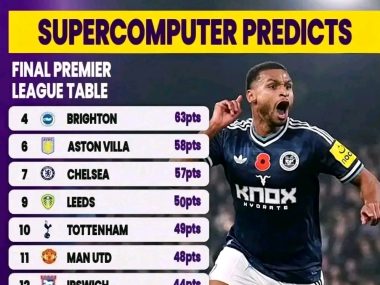
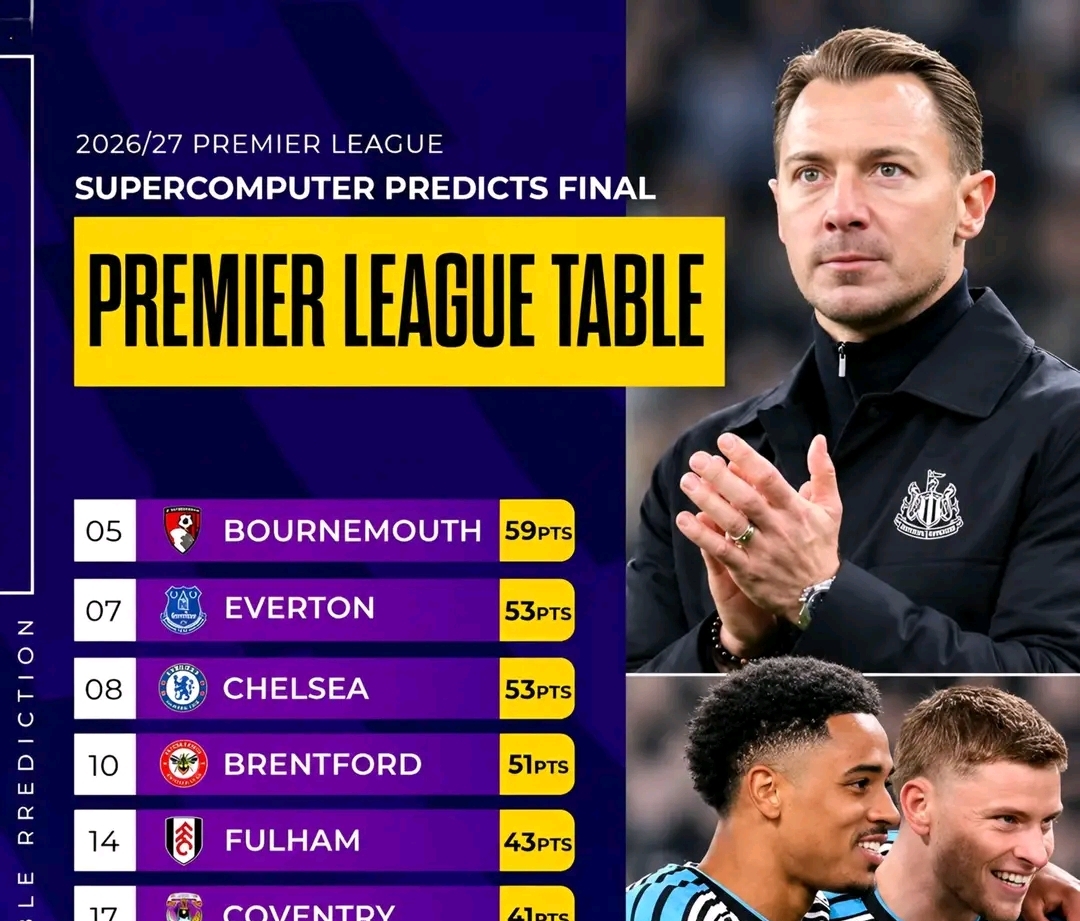
The honest answer, according to the data, is neither. The supercomputer currently projects Newcastle to finish in 12th place—a position that would represent stagnation rather than progress . That projection was made after 10 games and may shift slightly following the Arsenal draw, but the underlying numbers suggest a marginal adjustment at best.
The 4.8% Champions League probability tells its own story . For context, Bournemouth—a side with a fraction of Newcastle’s resources—have been given a 19.74% chance of Champions League football by the same model . Brighton, projected to finish third, are seen as far more credible contenders.
The Bigger Surprise?
If there is a surprise lurking in the supercomputer’s projections, it is not Newcastle’s Champions League charge. It is the possibility that the Magpies could yet be dragged into a relegation battle. A 14.3% chance of relegation is not insignificant . With a young squad low on confidence and a manager still learning the league, the floor for this Newcastle team is lower than many supporters would like to admit.
Yet the Arsenal performance offered evidence of a ceiling too. The second-half intensity, the tactical flexibility, the sheer refusal to fold against the champions—these are the qualities that could yet defy the algorithm.
For now, Newcastle fans must content themselves with a point that felt like a victory, a manager who showed he can adapt, and a supercomputer that remains deeply unconvinced. The Champions League dream is not dead. But according to the data, it is hanging by a thread.
Predicted final position: 12th
Champions League probability: 4.8%
Relegation probability: 14.3%
The supercomputer has spoken. The rest is up to Jaissle and his players.

 admin