 admin
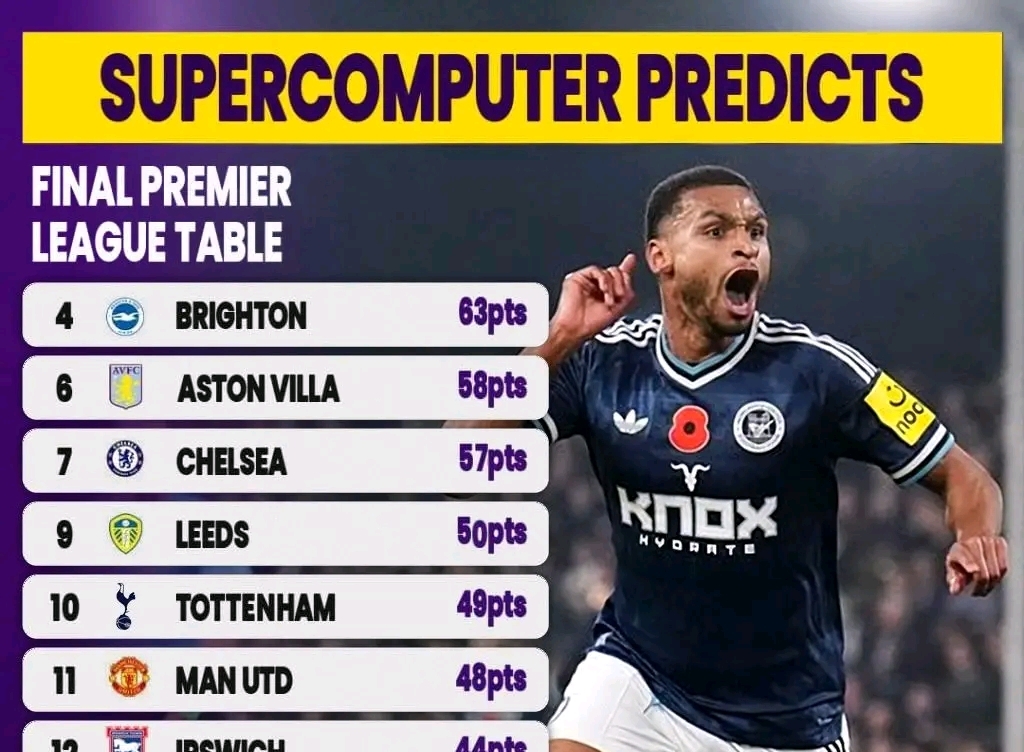
The Opta supercomputer has refreshed its projected final 2026-27 Premier League table following the opening months of the campaign, and the updated forecast delivers a stark contrast at both ends of the spectrum: Arsenal remain on course for back-to-back titles, while Manchester United are now tipped for a shocking mid-table finish—or worse .
Title Race: Arsenal in Command
Mikel Arteta’s Arsenal have picked up where they left off last season, winning nine of their opening ten fixtures and establishing a six-point cushion over Manchester City . The supercomputer now projects the Gunners to finish on 82 points, with a title probability of 74.61%—a commanding lead over their nearest rivals .
Manchester City sit second in the projected table on 70-71 points, though the club’s season is overshadowed by the guilty verdict for Premier League financial regulations and an ongoing appeal . The uncertainty surrounding City’s future has not yet dislodged them from the runners-up spot in Opta’s model, but the gap to Arsenal has widened considerably.
The most striking riser in the top four is Brighton & Hove Albion, projected to finish third on 67 points . Fabian Hürzeler’s side have produced statement victories over both Manchester City and Arsenal this term and have been backed with a 72.75% chance of qualifying for the Champions League . Liverpool, under Andoni Iraola, are tipped for fourth on 62 points, with Alexander Isak’s six goals in eight league games providing a rare bright spot in an otherwise inconsistent start .
Mid-Table: Chelsea’s Stumble, Spurs’ Recovery
Chelsea, heavily tipped before the season to challenge for the title given the absence of European football, have underwhelmed. Defeats to Arsenal, Brentford and Tottenham, plus a home draw with Hull City, have left Xabi Alonso’s side projected fifth on 60 points . Bournemouth and Aston Villa are level on 55 points in sixth and seventh respectively, with Everton (54), Brentford (53) and Tottenham (50) completing the top half .
Tottenham’s projection of tenth represents a modest recovery from a difficult opening, while Newcastle’s twelfth-place forecast reflects a turbulent summer at St James’ Park .
The Manchester United Crisis
The headline of the updated forecast is Manchester United’s dramatic fall. Michael Carrick’s side have managed just one win in their opening nine fixtures, and a 4-4 draw with Bournemouth left them in the actual relegation zone before the November international break—their longest spell in the bottom three since autumn 1986 .
Opta’s model projects United to recover to 13th place on 44-45 points, but the relegation probability stands at a startling 21.58% . For a club of United’s stature, a mid-table finish would represent a profound failure; relegation would be their first since 1974.
Relegation Battle: Sunderland Rock Bottom
At the foot of the projected table, Sunderland are tipped to finish 20th on 38 points, following a difficult second season back in the top flight . Crystal Palace (39 points) and Coventry City (40 points) join them in the bottom three, with the supercomputer anticipating a remarkably tight survival race in which even 40 points may not guarantee safety .
Fulham (43 points), Ipswich Town (43), Hull City (42) and Nottingham Forest (43) are all projected to be within a handful of points of the drop zone, underscoring the margins that could define the season at the bottom .
Caveats and Context
It is worth noting that the supercomputer’s projections are based on current form and carry no predictive guarantee. Manchester City’s appeal against their financial regulations verdict could fundamentally alter the competitive landscape depending on its outcome . Additionally, the model’s figures have fluctuated across the season—earlier iterations placed United as high as fifth and Brighton as low as sixth—demonstrating that a few results can shift the forecast considerably .
What the updated table does reveal, however, is a season of unusual volatility: Arsenal’s dominance at the summit, Brighton’s emergence as genuine top-four material, and the alarming descent of Manchester United into the kind of territory the club has not occupied in over half a century.


 admin