 admin
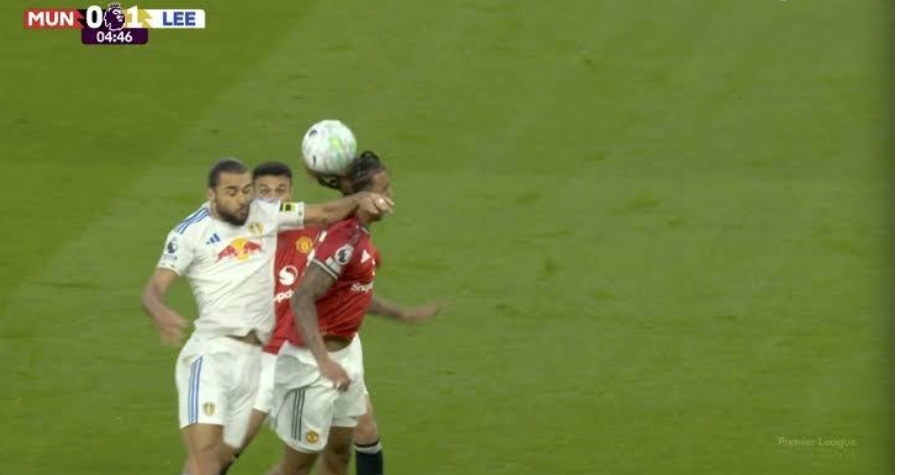
adminFew rivalries in English football are as fiercely charged as Manchester United vs. Leeds United, and this scene perfectly captures why. Just five minutes into the Premier League match, tension was already running high when a lofted ball sparked a physical clash that quickly veered into disputed territory.
As the ball descended, a United forward leapt to meet it, eyes locked upward, body set for a header. Close behind, a Leeds defender tracked his every move. Then came a split-second interaction ripe for debate: the defender raised his arm, making contact with the United player’s face and neck. The impact was unmistakable. The attacker winced in midair, his balance thrown off as the ball glanced away.
From one perspective, it was a textbook case of a defender “using the arms for leverage”—a long-accepted tactic in aerial battles. From another, it bordered on dangerous: the arm was high, extended, and at best careless, at worst reckless. The referee waved play on, and in that moment, a debate was ignited—one likely to outlast the final whistle.
Such incidents occupy a gray area in football’s laws. Players are allowed to use their arms for balance when jumping, but forceful contact with an opponent’s head or face changes the calculation. Referees must weigh intent, force, and consequence—three factors rarely aligned in real time. Was it a natural motion exaggerated by momentum, or a calculated move to gain an edge?
For Manchester United supporters, the answer is clear: injustice. The contact disrupted a fair aerial challenge and carried clear risk. In today’s game, with its growing emphasis on player safety, such actions often draw at least a foul, if not a card. Leeds fans see it differently. Football remains a physical sport. Aerial duels are messy, bodies collide, arms rise. Penalizing every brush of contact, they argue, would sap the game of its intensity.
What fuels the fire is VAR’s role—or lack thereof. The system was designed to catch clear and obvious errors, especially those involving potential red cards. Yet moments like this often fall into a frustrating middle ground: not blatant enough for a reversal, but contentious enough to dominate post-match talk. When VAR stays silent, it often deepens the sense of inconsistency rather than resolving it.
Beyond the rulebook, this moment speaks to the enduring heat of the United-Leeds rivalry. It’s not just about points; it’s about pride, history, and raw emotion. Every tackle feels sharper, every duel more intense, and every refereeing decision judged under a harsher light.
In the end, the incident encapsulates football itself—a sport forever balancing physicality with fairness. Whether seen as a missed foul or simply part of the game’s rough-and-tumble nature, it shows how a single moment can spark widespread debate. And in a rivalry as fierce as this one, such moments are never fleeting—they become part of the story, replayed and reinterpreted long after the match ends.

 admin
admin