 admin
adminThe controversial decision to disallow Brennan Johnson’s goal during Everton’s Premier League clash against Hull City has sparked widespread debate, with supporters demanding a clearer explanation of the incident and the role played by the Video Assistant Referee (VAR).
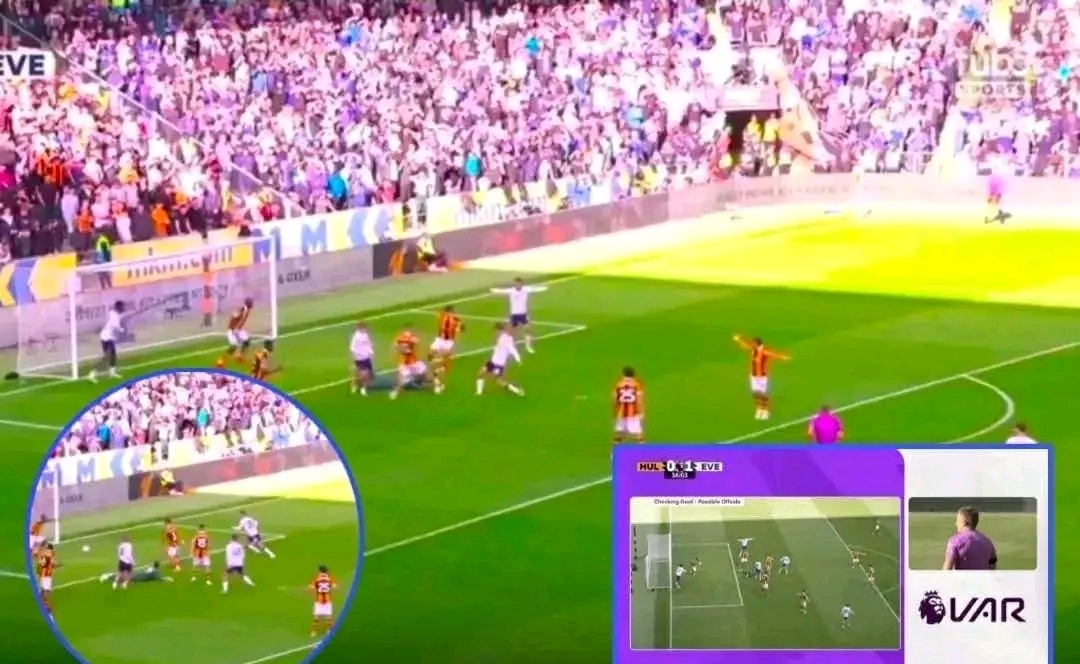
Johnson thought he had given Everton the lead after finding the net in the first half at the MKM Stadium on Sunday. However, his celebrations were cut short when referee Michael Salisbury reviewed the incident and overturned the original decision following a VAR intervention.
The decision quickly became one of the major talking points of the encounter, with questions raised about Johnson’s positioning, his involvement in the attacking move and whether the officials had made the correct call.
Despite claims circulating online about an official statement from the Football Association, there was no independently verified FA statement confirming that the governing body had issued a fresh explanation of the incident. The confirmed explanation came through the Premier League’s match officials.
WHY WAS BRENNAN JOHNSON’S GOAL DISALLOWED?
The incident occurred in the first half when Everton launched an attack that initially appeared to have produced the opening goal of the afternoon.
A cross from Jarrad Branthwaite caused problems inside the Hull City penalty area, with goalkeeper Konstantinos Tzolakis struggling to deal with the situation.
Harrison Armstrong collected the loose ball and attempted a shot towards goal, but Hull defender Nobel Mendy blocked the effort. Ryan Giles then attempted to clear the danger, only for the ball to strike Johnson and end up in the net.
Johnson immediately celebrated what he believed was his first Premier League goal for Everton. However, the officials subsequently reviewed the sequence of events.
Following the review, Salisbury ruled that Johnson had been in an offside position when Armstrong’s shot was taken and had interfered with an opponent during the subsequent action.
The Premier League Match Centre explained that the goal was overturned because Johnson was in an offside position and was deemed to be challenging an opponent for the ball.
That explanation became central to the debate, as the officials were not simply assessing where Johnson was standing. They also had to determine whether his involvement constituted an offside offence under the Laws of the Game.
PAT NEVIN’S REACTION ADDS TO THE CONTROVERSY
The decision also attracted attention because BBC Radio 5 Live commentator Pat Nevin reportedly expressed confusion over why the goal had been disallowed.
His reaction added another dimension to the discussion, with supporters questioning whether the available television footage made the reasoning behind the decision sufficiently clear.
However, confusion surrounding a decision does not automatically mean that the officials were wrong. The key issue remains whether Johnson was offside when the ball was played and whether his subsequent involvement interfered with an opponent.
The incident has once again highlighted the challenges involved in explaining complex offside decisions to viewers, particularly when a goal is overturned after the initial celebrations have begun.
WHAT DO THE RULES SAY ABOUT OFFSIDE?
Under football’s Laws of the Game, being in an offside position does not automatically constitute an offence.
An attacker must also become involved in active play in one of the ways specified by the rules, including interfering with an opponent or gaining an advantage from that position.
In Johnson’s case, the officials determined that his positioning and involvement in the incident met the requirements for an offside offence.
Former Premier League official Darren Cann also backed the decision, describing the VAR intervention as correct and praising the officials for reviewing the incident at the pitchside monitor.
His assessment offered support for the decision, although the debate surrounding the incident continued among supporters.
DAVID MOYES QUESTIONS THE DECISION
Everton manager David Moyes also addressed the disallowed goal after the match, acknowledging the offside explanation while raising a question about the goalkeeper’s positioning.
Moyes said he accepted that Johnson could have been offside when Armstrong’s shot was blocked, but questioned whether the goalkeeper’s heel might have kept the Everton attacker onside.
The manager’s comments reflected Everton’s frustration over the incident, particularly because Johnson appeared to have put his team ahead before the intervention.
Nevertheless, the official decision stood, and Everton had to continue the match without the goal.
HOW THE MATCH FINISHED
The controversy did not prevent the encounter from producing an entertaining second half.
Hull City took the lead through Joe Gelhardt in the 49th minute after an error from Everton defender Ainsley Maitland-Niles.
Everton responded when Kiernan Dewsbury-Hall headed home an equaliser, before Thierno Barry put the visitors ahead.
However, Mohamed Belloumi came off the bench to score Hull City’s second goal, securing a 2-2 draw and ensuring that the home supporters had something to celebrate.
The result left Everton unbeaten in the league, although Moyes was frustrated by his team’s performance and the opportunities they failed to convert.
Ultimately, Johnson’s disallowed goal remains a major talking point from the match. While the officials provided an explanation based on offside and interference with an opponent, the incident has renewed calls among football supporters for clearer communication whenever VAR overturns an important goal.
Sources: Premier League match officials’ explanation and match reporting from Sports Mole, Sky Sports and The Guardian.

 admin
admin