 admin
adminWhat was supposed to be a thrilling European showdown turned into the season’s most contentious match, as FC Porto were left furious, stunned, and eliminated following a call that reverberated across the football world.
In a packed stadium with everything at stake, the UEFA Europa League quarter-final second leg between Porto and Nottingham Forest promised high drama. Yet even the most imaginative storyteller couldn’t have foreseen the chaos that erupted within the first few minutes.
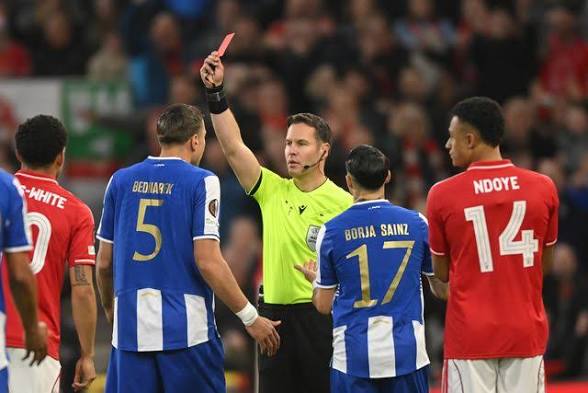
Only eight minutes in, disaster struck. A Porto defender, trying to stop a dangerous attack, brought down a Forest player who seemed destined for a one-on-one with the goalkeeper. The referee acted instantly: a red card. No caution, no second look—just immediate upheaval.
From that point, the game transformed completely. Porto players surrounded the official in furious protest—arms waving, voices raised, disbelief etched on their faces. On the sideline, the coaching staff mirrored the outrage, gesturing frantically as the harsh reality set in: over 80 minutes left with ten men.
Fans worldwide were equally divided. Was it the right decision? Or had the referee effectively decided the tie in a split second? Replays only intensified the debate.
Some camera angles suggested a covering defender might have been present—a key detail that could have reduced the punishment to a yellow card. Others showed clear contact, supporting the referee’s interpretation of denying an obvious goal-scoring opportunity. But in high-stakes football, “technically correct” doesn’t always feel “fair”—and Porto made their displeasure clear.
When play resumed, the psychological toll was immediate. Nottingham Forest seized control, pushing forward with purpose. Moments later, Morgan Gibbs-White delivered the decisive blow, slotting home calmly to give Forest the lead and shift the tie firmly in their direction.
For Porto, it felt like the beginning of the end.
Despite being a man down, they fought valiantly—pressing when possible, defending desperately, and coming agonizingly close to a late equalizer. A thunderous strike rattled the crossbar, a moment that could have rewritten the story. But luck had apparently picked its side.
At the final whistle, the score stood at 1–0 on the night, enough to send Forest through on aggregate. Yet the result was almost secondary to the uproar that followed.
Porto’s camp erupted. Club officials reportedly demanded a formal review of the decision, with strong calls for UEFA to investigate the officiating. Fans flooded social media, decrying the moment as a “robbery,” while pundits across Europe dissected the incident in heated debates that show no sign of cooling.
Was it a fair application of the rules, or an overreach that ruined the contest? Even neutral observers are torn. Some argue rules are rules—the attacker was through, the foul was clear, and the red card was justified. Others insist that in such a massive match, the referee should have shown more discretion, especially so early on.
One thing is certain: the decision didn’t just influence the match—it defined it.
For Porto, it’s a painful night that will linger as an unanswered “what if.” For Nottingham Forest, it’s a step closer to European glory, though not without controversy shadowing their achievement.
And for the football world? It’s yet another reminder that in the biggest moments, a single call can bring everything crashing down.

 admin
admin