 admin
adminHarry Kane’s missed penalty has become one of the major talking points from England’s dramatic 3-2 defeat to Spain at Wembley, with questions continuing to surround the circumstances of the spot kick.
England appeared to have a golden opportunity to extend their advantage when Jude Bellingham went down inside the penalty area following a challenge involving Rodri. The referee initially allowed play to continue, but VAR intervened and the incident was subsequently reviewed before a penalty was awarded to England.
Kane stepped up with England leading 2-1, knowing that converting from 12 yards would give Thomas Tuchel’s side a two-goal cushion.
Instead, the England captain slipped as he attempted the kick and the ball struck the crossbar.
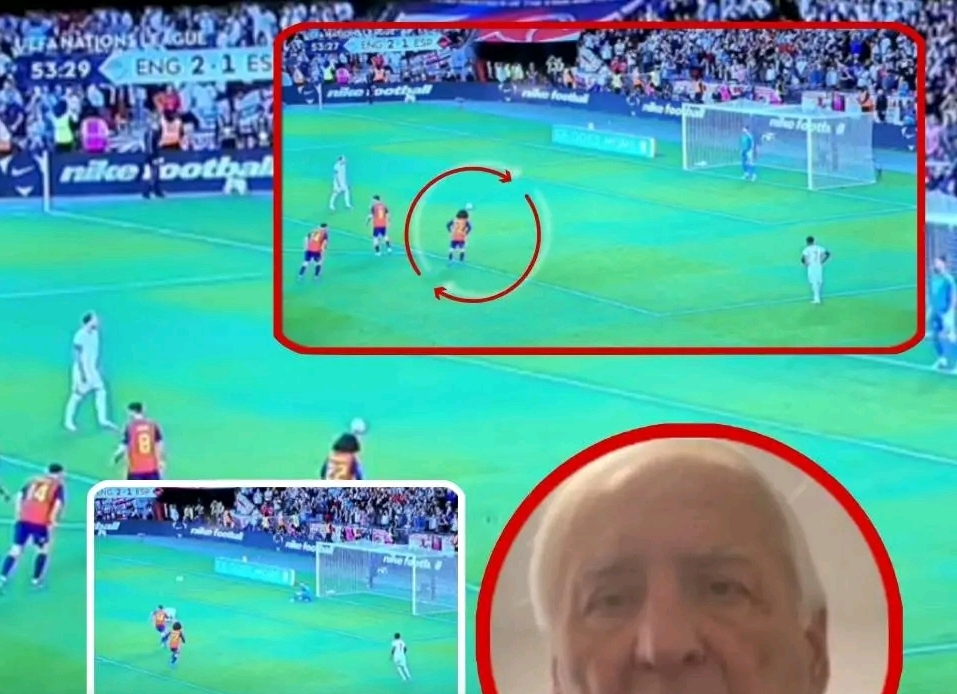
The incident immediately became controversial for another reason. Replays indicated that Kane made contact with the ball with both feet during his attempt, adding a complicated Law 14 issue to an already dramatic moment. Under the current rules, the outcome of an accidental double touch depends partly on whether the ball enters the goal. In Kane’s case, it struck the bar and did not enter the net.
Questions Over Spanish Encroachment
The debate did not end with Kane’s slip.
Images and replays prompted some England supporters to question whether Spanish players had entered the penalty area before Kane struck the ball.
Law 14 requires players other than the penalty taker and goalkeeper to remain outside the penalty area and behind the penalty mark until the kick is taken. However, the modern interpretation of the law does not mean that every instance of encroachment automatically results in a penalty being retaken.
The circumstances surrounding the infringement are important.
For example, an encroaching defending player can be penalised where the encroachment clearly affects the kicker or where the player subsequently becomes involved in the play in a way that prevents the attacking team from scoring or creating a scoring opportunity.
That distinction has become central to the discussion surrounding Kane’s penalty.
Simply identifying a Spanish player with part of their body inside the area is not, on its own, enough to establish that a retake was mandatory.
Where Keith Hackett Comes Into The Debate
Former PGMOL chief and FIFA referee Keith Hackett has previously discussed penalty-kick encroachment and the way the modern laws are applied.
His analysis of a similar situation involving West Ham and Charlton in August highlighted the significant change in the law. Hackett explained that under the laws used during his refereeing career, obvious encroachment would have resulted in a retake, whereas the current wording places greater emphasis on whether the encroachment actually affected the outcome.
However, it is important to distinguish that analysis from the England-Spain incident.
There is currently no reliable confirmation that Hackett specifically stated that Kane’s penalty should have been retaken because a Spanish player encroached during the kick. The central issue therefore remains the application of Law 14 rather than an established claim that the officials definitely made an error.
Why The Moment Became So Important
Kane’s miss was particularly costly because England were in front.
Spain had opened the scoring through Lamine Yamal before Anthony Gordon restored parity. Kane then headed England into a 2-1 lead, putting the hosts in a strong position before the penalty opportunity arrived.
A successful penalty would have made it 3-1.
Instead, the ball hit the crossbar.
Spain responded strongly and eventually turned the match around. Alex Baena equalised before Mikel Oyarzabal completed Spain’s comeback, giving the visitors a 3-2 victory.
The timing made Kane’s miss even more significant.
England had appeared to have control of the contest, but Spain quickly regained momentum after the penalty incident.
Different From Kane’s World Cup Retake
The situation has also been compared with England’s 2026 World Cup match against Croatia, when Kane was given another opportunity after initially failing to score from the spot.
In that incident, VAR identified goalkeeper Dominik Livaković moving off his goal line before Kane took the penalty. The kick was therefore retaken, and Kane converted the second attempt. Hackett also described the decision as the correct application of the law.
The Spain incident was different.
There was no comparable goalkeeper infringement, while Kane’s apparent double touch introduced another issue that had to be considered.
That is why comparisons between the two incidents can be misleading.
One Penalty, Several Controversies
Kane’s penalty against Spain ultimately involved several separate talking points.
There was the original decision to award the penalty after the VAR review involving Bellingham and Rodri.
There was Kane’s slip during the kick.
There was the apparent double contact with the ball.
And there were questions about possible Spanish encroachment.
Each issue has to be considered separately under the relevant laws.
UEFA’s guidance on penalty-area incidents also emphasises that officials must consider the nature and impact of contact rather than automatically treating every form of contact or movement as an offence.
For England supporters, however, the timing of the incident remains particularly frustrating.
The penalty came when England had an opportunity to move 3-1 ahead, but Kane’s miss was followed by Spain’s comeback.
The defeat therefore ensures that the penalty will remain one of the defining moments of the match.
Still, the result cannot be attributed entirely to Kane’s miss. England had significant time remaining after the penalty and conceded twice before the final whistle.
The encroachment debate may continue, but under the current laws, the mere presence of a Spanish player inside the penalty area would not automatically prove that Kane deserved another attempt.
The key question is whether any encroachment met the specific conditions for intervention — and that makes the incident considerably more complicated than a simple case of “player crossed the line, therefore retake.”


 admin
admin