 admin
adminFIFA has officially closed the book on one of the most contentious issues of the 2026 World Cup, putting an end to days of heated debate over the anti-England banner unfurled by Argentina fans after their dramatic semifinal victory.
Following a thorough internal investigation and careful evaluation of all available evidence, world football’s governing body confirmed that no disciplinary measures would be taken against Argentina—a ruling that has sharply split opinions across the global football community.
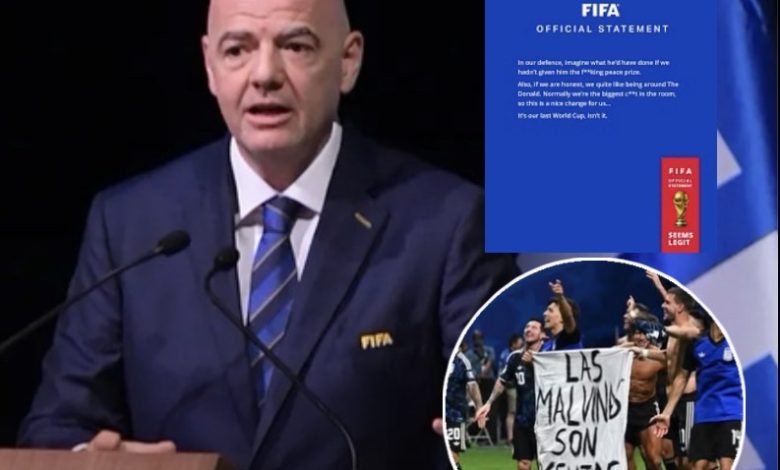
The uproar began shortly after Argentina edged past England 2-1 in a fiercely competitive semifinal. While initial post-match analysis centered on Lionel Scaloni’s tactical brilliance and Argentina’s composure under pressure, the narrative quickly shifted when footage emerged of Argentine supporters celebrating with a large banner explicitly targeting England.
Images of the display circulated rapidly on social media, drawing reactions from thousands of fans, former professionals, and pundits alike, all questioning whether FIFA would step in.
Many English supporters viewed the banner as unacceptable and expected sanctions comparable to those previously issued for political or offensive displays at major tournaments.
FIFA’s initial silence over the following days only fueled speculation that disciplinary proceedings were quietly progressing.
After what FIFA described as an exhaustive review, the governing body concluded that the incident did not violate its disciplinary code at a level warranting sporting penalties against the Argentine Football Association. Officials cited several decisive factors in their final ruling.
First, investigators determined that the banner was the act of a minority of supporters rather than an orchestrated initiative endorsed by the Argentine FA or the national squad.
FIFA’s regulatory framework typically differentiates between isolated fan behavior and conduct actively promoted or sanctioned by competing teams.
Second, FIFA found no proof that Argentine players, coaching staff, or federation representatives encouraged, displayed, or endorsed the banner during the celebrations. Consequently, responsibility could not be automatically assigned to the national association.
Finally, while acknowledging that the banner caused significant offense and drew widespread criticism, FIFA ruled that the available evidence did not meet the necessary threshold for disciplinary action under its existing regulations.
The announcement has done little to soothe tensions.
English supporters reacted with anger, accusing FIFA of inconsistency in handling supporter-related incidents across recent tournaments. Many drew comparisons to earlier cases where national associations were penalized for crowd conduct, insisting that the same standards should apply regardless of the nation involved.
Others suggested football’s governing body had squandered an opportunity to deliver a clear statement against provocative acts that could inflame international rivalries.
Social media exploded with debate immediately after FIFA’s explanation was published.
Some fans defended the ruling, contending that football has always thrived on passionate rivalries and emotional fan expression. They argued that governing bodies should refrain from punishing entire nations for the behavior of a small subset of supporters unless definitive evidence of coordinated misconduct exists.
Conversely, others maintained that the sport’s premier tournament should uphold the strictest standards, warning that controversial banners risk tarnishing the competition’s reputation.
This episode inevitably adds another layer to the historic England-Argentina football rivalry.
Few international matchups carry such deep historical resonance. Decades of unforgettable World Cup clashes—ranging from iconic encounters to dramatic knockout ties—have fueled intense emotions on both sides, with memories that remain seared into football lore.
Even if modern players tend to prioritize football over politics or historical grievances, supporters often bring those sentiments into the stands, generating an atmosphere unmatched by most other international fixtures.
This latest controversy once again highlights how quickly off-pitch events can dominate headlines, even after a thrilling semifinal packed with outstanding football.
Argentina themselves have remained focused on final preparations, refusing to let the disciplinary debate distract from a potential historic achievement. Players have largely avoided public comment on FIFA’s decision, opting instead to concentrate on training and recovery ahead of the tournament’s showpiece match.
England’s camp has similarly refrained from escalating matters, choosing to channel their energy into processing the disappointment of falling short of another final, despite a commendable campaign.
Nevertheless, the ruling raises broader questions for FIFA moving forward.
As football grows increasingly global, governing bodies face mounting pressure to apply disciplinary regulations consistently, while balancing freedom of expression, fan culture, and event integrity. Supporters, clubs, and associations will inevitably scrutinize future disciplinary decisions through the prism of this controversy, comparing outcomes whenever similar incidents occur.
If FIFA seeks to avoid allegations of double standards, many argue that clearer guidelines on supporter conduct and federation accountability may be essential before upcoming international competitions.
For now, however, the case appears officially closed.
Argentina will face no fine, points deduction, or other sporting penalty over the anti-England banner controversy. FIFA maintains that its investigation uncovered insufficient grounds for disciplinary proceedings, even as it acknowledges the widespread debate the episode generated.
Whether that explanation satisfies football supporters is entirely another matter.
For England fans, the verdict is likely to remain a bitter pill, especially given the rivalry’s emotional weight and expectations surrounding FIFA’s disciplinary consistency.
For Argentina, the ruling removes a significant distraction at the most pivotal stage of the tournament, enabling full focus on their quest for another World Cup crown.
Yet the broader conversation will almost certainly persist long after the final whistle. FIFA may have delivered its verdict, but among millions of supporters worldwide, opinions remain deeply fractured over whether true justice has been served.


 admin
admin