 admin
adminFIFA Explain Controversial England Equaliser After Spider-Cam Debate During Norway Clash
England’s World Cup Quarter-Final Triumph Over Norway Overshadowed by Spider-Cam Controversy
England’s dramatic 2-1 extra-time victory over Norway in the FIFA World Cup quarter-finals has become one of the tournament’s most debated matches, following FIFA’s official explanation regarding Jude Bellingham’s pivotal equalizer.
The goal, which came amid claims that the ball may have clipped an overhead spider-cam cable in the build-up, has sparked fierce discussion among fans and pundits alike.
The flashpoint occurred just before the interval. Norway goalkeeper Ørjan Nyland launched a long goal-kick from deep inside his own area.
Television footage suggested the ball passed perilously close to the suspended camera wires above the pitch, with many viewers speculating that it made contact before landing in England’s attacking third.
Elliot Anderson reacted sharply to the loose ball, and after a swift exchange, Bellingham fired home the equalizer a mere eight seconds after Nyland’s kick.
The match remained locked at 1-1 through regular time, but Bellingham struck again in extra time to secure England’s place in the semi-finals under Thomas Tuchel.
The incident immediately ignited a firestorm of debate among supporters, analysts, and former officials, with many questioning whether play ought to have been halted before England capitalized.
The Source of the Dispute
Under the IFAB Laws of the Game, if the ball makes contact with an external object—such as suspended camera rigging—while in active play, the referee must stop the match and restart with a dropped ball.
Given that the alleged contact occurred immediately prior to England regaining possession and scoring, Norwegian players and supporters argued vehemently that the goal should have been ruled out.
Slow-motion replays shared widely on social media appeared to show a subtle deviation in the ball’s flight path, intensifying suspicions that the overhead cable had interfered with play. Norway’s players surrounded referee Clément Turpin in protest following the equalizer, and their dismay only deepened after the full-time whistle as England celebrated their comeback victory.
FIFA’s Official Response
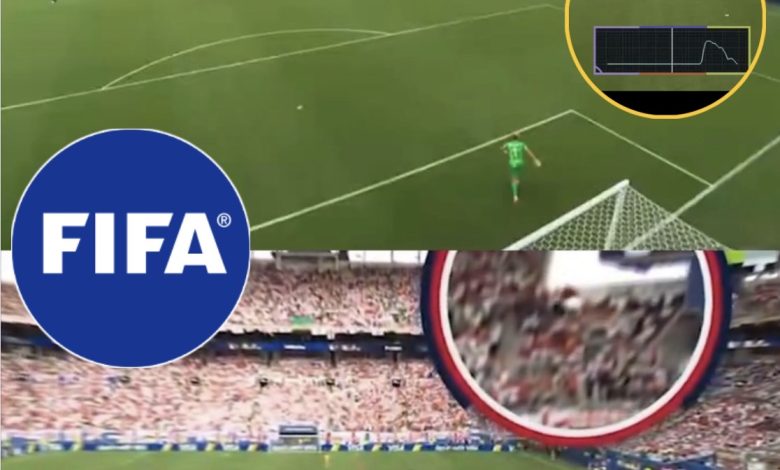
In response to the uproar, FIFA clarified that match officials had relied on data from the embedded sensor within the official Adidas match ball—part of the Connected Ball Technology system.
According to FIFA, the sensor recorded no impact data or abnormal fluctuations that would indicate a collision with the spider-cam cable during the ball’s trajectory.
With no technological evidence of contact, officials determined there was no grounds to disallow the goal, effectively sidestepping what could have been one of the tournament’s most contentious calls—though the ruling failed to placate many Norwegian fans.
Understanding Connected Ball Technology
This incident has cast a fresh spotlight on FIFA’s Connected Ball Technology, one of the governing body’s most sophisticated officiating tools. The World Cup ball houses an inertial measurement unit (IMU) sensor that operates at roughly 500Hz, continuously capturing acceleration and three-dimensional movement data. This information is relayed in real-time to match officials and the VAR team, enabling more precise detection of contact between the ball and players. In this instance, FIFA asserted that the sensor yielded no evidence of any collision with the overhead cable.
Norwegian Frustration Persists
Despite FIFA’s technical explanation, Norway’s camp remained unconvinced. Players, coaching staff, and fans continued to argue that the visual evidence pointed to an unnatural change in the ball’s flight before it dropped into England’s attacking zone.
Manager Ståle Solbakken questioned why the incident wasn’t subjected to greater scrutiny, while goalkeeper Ørjan Nyland reiterated his belief that the ball had indeed struck the cable. The defeat marked the end of Norway’s impressive World Cup run, making the controversy all the more bitter for the team and its supporters.
Former Referee Weighs In
Former Premier League official Mark Clattenburg added to the discourse, suggesting that if the ball had genuinely struck the spider-cam during the attacking phase leading to a goal, VAR would have been entitled to intervene as it was part of the build-up to a scoring opportunity. Ultimately, however, FIFA’s sensor data formed the cornerstone of the governing body’s conclusion that no contact occurred, thereby precluding any need for intervention. Clattenburg’s remarks nonetheless reignited debate about how VAR should handle unusual incidents involving stadium infrastructure.
England’s Silver Lining
For England, the controversy scarcely diminished the achievement of a stirring comeback. Norway had taken an early lead before Bellingham restored parity just before halftime.
With the score deadlocked at 90 minutes, extra time was required, and Bellingham once again proved the hero, netting the decisive second goal to seal a 2-1 victory and propel England into the semi-finals.
The Real Madrid midfielder’s two-goal performance further cemented his standing as one of the Three Lions’ most influential performers on the global stage.
Social Media Divide
The incident quickly became one of the tournament’s most hotly debated topics. Many England supporters accepted FIFA’s explanation, contending that sensor technology offers more reliable evidence than long-distance television angles.
Others pointed out that camera perspectives can create optical illusions, especially when judging whether a fast-moving ball has grazed a slender overhead wire. Norwegian fans, however, remained deeply skeptical, arguing that the visual footage warranted a more exhaustive review regardless of the sensor output.
The disagreement underscored the growing friction between traditional video evidence and modern tracking technology in football.
Technology Meets Human Perception
The episode also highlighted football’s increasing dependence on advanced tools. Today’s World Cup matches incorporate goal-line technology, semi-automated offside systems, Connected Ball Technology, high-speed tracking cameras, and VAR review protocols—all designed to enhance decision-making and reduce human error.
Yet incidents like England’s equalizer against Norway demonstrate that even cutting-edge technology cannot entirely eradicate controversy. When television images appear to contradict sensor readings, fans are left to ponder which source should carry greater weight. In this case, FIFA placed its trust in the connected ball over the broadcast footage.
The Letter of the Law
What Lies Ahead
According to the IFAB Laws of the Game, contact between the ball and an external agent—such as suspended camera equipment—requires the referee to stop play and restart with a dropped ball. The crux of the matter, however, was whether such contact had actually occurred.
FIFA’s review found no evidence that the ball had touched the cable. Without confirmation of contact, there was no legal basis to annul the goal or halt play, a conclusion that effectively settled the matter from the governing body’s standpoint.
Tuchel’s Perspective
While the controversy dominated post-match headlines, England manager Thomas Tuchel chose to emphasize his team’s resilience. The Three Lions had to dig deep after falling behind to a stubborn Norwegian side, eventually finding the breakthrough in extra time.
Tuchel conceded that England hadn’t been at their fluent best but praised his players’ character in overcoming a stern test to secure a semi-final berth.
With FIFA having issued a public explanation, there appears little chance of any alteration to the result. The governing body regards the connected ball data as definitive proof that the ball never struck the spider-cam cable, leaving Bellingham’s equalizer valid.
England therefore retain their semi-final spot, while Norway’s commendable tournament run draws to a close. Though debate among fans is likely to persist for some time, the official decision appears final.
A Moment to Remember
Major tournaments are often defined by moments of brilliance, heartbreak, and controversy—and England’s victory over Norway delivered all three. Bellingham’s goals secured England’s passage to the last four, but it was the unusual prelude to his first strike that has already entered World Cup folklore.
Whether supporters side with the television replays or FIFA’s sensor technology, the incident has sparked a vital conversation about how modern football navigates the intersection of technology, officiating, and the Laws of the Game.
For FIFA, the verdict was unequivocal: the connected ball recorded no contact with the spider-cam cable, so there was no reason to disallow the goal. For Norway, however, the debate shows no sign of fading.
As England gear up for their semi-final showdown, the controversy surrounding Bellingham’s equalizer will remain one of the enduring narratives of the 2026 FIFA World Cup—a vivid illustration of how even the smallest moments, and the smallest pieces of technology, can shape football’s grandest occasions.


 admin
admin