 admin
adminNottingham Forest were left frustrated after seeing Neco Williams’ controversial goal ruled out during their goalless Premier League draw with Tottenham Hotspur at the City Ground earlier this month.
The decision sparked plenty of debate, with Williams insisting that the ball had not struck his arm. However, Howard Webb has now stepped forward to explain why the officials ultimately had no option but to disallow the goal.
Williams appeared to have given Forest the lead midway through the second half after throwing himself into a chaotic goalmouth scramble involving Tottenham midfielder Sandro Tonali.
The Wales international went headfirst towards the ball as Tonali attempted to clear it, with the Tottenham player’s boot making contact with Williams’ head in the process. Williams then bundled the ball over the line, seemingly putting Forest ahead.
However, Video Assistant Referee Peter Bankes and his assistant, Alex Chilowicz, intervened after determining that the ball had made contact with Williams’ arm before entering the net.
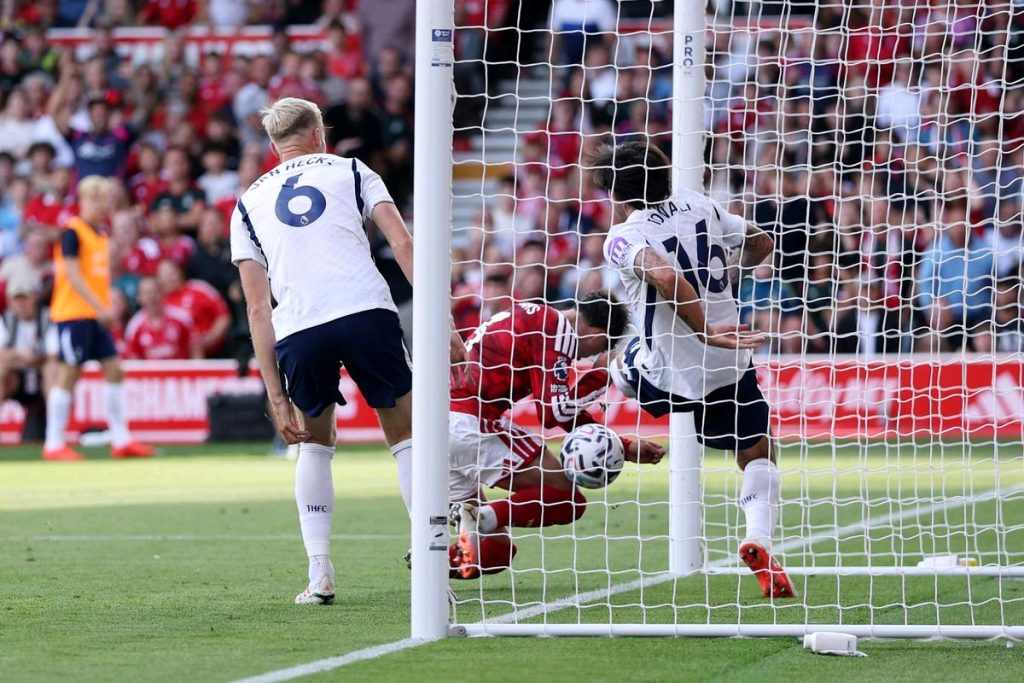
The goal was subsequently chalked off for accidental handball, despite Williams strongly disputing the decision after the match.
The Forest defender maintained that the available replays did not prove the ball had touched his arm.
“I’ve seen the images and the replays, and at not one moment did I think I handballed it,” Williams said. “I have seen all the images, and at not one moment can you tell that has clearly hit my arms, because it never. I knew straight away I’ve headed it down in between my arms. It didn’t hit my arm.”
The controversy continued to generate discussion, prompting Webb to address the incident during Tuesday night’s edition of TNT Sports’ Match Officials Mic’d Up.
Webb, who serves as Chief Refereeing Officer at Pro Ref, formerly PGMOL, explained that the incident was not judged according to the usual “clear and obvious” VAR threshold because the key issue was establishing a matter of fact.
According to Webb, the law requires a goal to be disallowed if the ball touches an attacking player’s arm immediately before the player scores or the ball enters the net, even when the handball is accidental.
He explained that the VAR initially struggled to reach a conclusive verdict but eventually found the correct camera angle and slowed the footage down sufficiently to establish what happened.
Webb said the replay showed the ball clearly striking Williams’ right arm, with movement in his shirt sleeve providing further evidence.
He pointed specifically to the movement of the sleeve and the three stripes on Williams’ kit as evidence that the ball had made contact with the arm.
Webb also suggested that the incident might have been harder to identify had Williams been wearing short sleeves, but the movement was sufficiently obvious in the available footage.
Once the VAR had conclusively established that the ball struck Williams’ arm before entering the goal, the officials were required to intervene.
Webb stressed that the decision was made before the ball crossed the goal line and that the incident was also checked to ensure the timing of the handball was correct.
Ultimately, while Webb acknowledged that the decision was harsh on Williams and Nottingham Forest, he insisted that the officials were simply applying the wording of the handball law.
The explanation is unlikely to completely end the debate surrounding the incident, particularly given Williams’ firm belief that the ball never touched his arm. However, Webb’s comments make clear why VAR considered the evidence sufficient to overturn what initially appeared to be a legitimate Forest goal.


 admin
admin